

The unbeatable math of Rock Paper Scissors
Discover the surprising mathematical strategies that can help you win every game of Rock Paper Scissors.
11/29/20252 min read
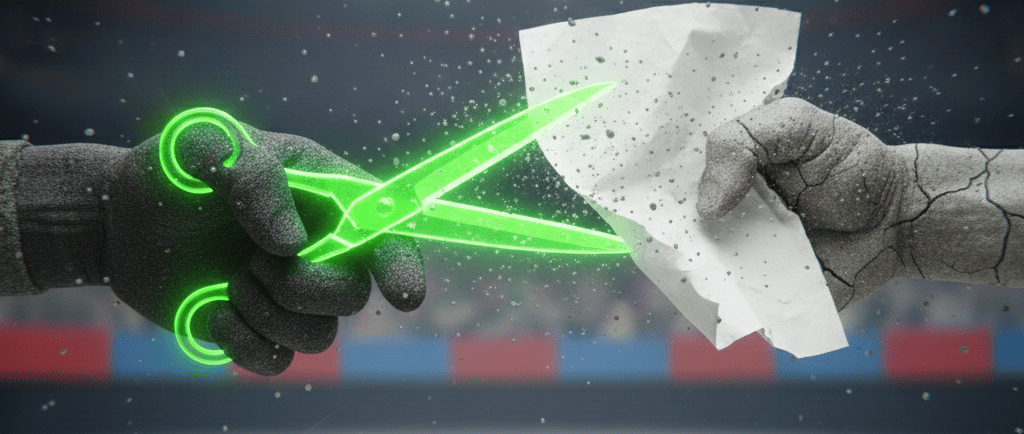

Rock Paper Scissors (RPS) might seem like a simple playground game, but beneath its three-option simplicity lies a perfect illustration of fundamental mathematical game theory concepts. It’s a game of perfect information, zero-sum dynamics, and a brilliantly balanced equilibrium that makes it fundamentally fair-if played correctly.
The Zero-Sum Arena
The first core concept is that RPS is a zero-sum game. This is a central idea in game theory where one participant's gains are always perfectly balanced by the other participant's losses.
In any given match:
If you win, your opponent loses (+1 for you, -1 for them).
If you draw, no value changes hands (0 for both).
The "sum" of the outcomes for all players is always zero. This creates an inherently competitive environment where every decision matters acutely to the final outcome.
The Elusive Pure Strategy: Why You Can't Win with Just Rock
In many competitive games (like Tic-Tac-Toe, if played perfectly), there is a pure-strategy Nash equilibrium-a single best move or sequence of moves that guarantees the best possible outcome.
Rock Paper Scissors has no such simple answer.
If you decide to be a "Rock Person" and play Rock every time, an observant opponent will quickly switch to playing Paper consistently, beating you every round. You would immediately want to change your strategy, which means your original strategy wasn't an equilibrium. The game’s design forces players into a state of constant strategic flux.
The Perfect Play: The Mixed-Strategy Nash Equilibrium
So, how do you play perfectly? By embracing unpredictability.
The only stable, mathematically optimal strategy in Rock Paper Scissors is a mixed strategy: choosing each of the three options with an exactly equal probability of one-third (1/3).
To achieve this perfect game theory equilibrium, you must:
Randomize Completely: Use a truly random method (like rolling a die or using a random number generator) to select your move. Do not allow human psychology or intuition to interfere.
Ensure Uniform Distribution: Play Rock 33.3% of the time, Paper 33.3% of the time, and Scissors 33.3% of the time over a series of games.
By employing this mixed strategy, you make yourself completely unpredictable. No matter what your opponent chooses, their expected payoff against you is precisely zero. You neutralize their ability to exploit any pattern, ensuring the game remains fundamentally fair.
The Human Element: Exploiting Imperfection
Game theory tells us how to play perfectly, but human players are imperfect. Studies in behavioral economics show we are notoriously bad at being truly random.
Common human biases include:
"Recency bias": Players tend to repeat winning moves or switch moves after a loss (the "win-stay, lose-shift" pattern).
Initial biases: Many casual players favor "Rock" as their default first move because it feels powerful.
A skilled human player, or perhaps a machine learning algorithm analyzing play patterns, can actually gain an advantage by predicting and exploiting these psychological biases.
In summary, the mathematical beauty of Rock Paper Scissors lies in its elegant simplicity. It provides a perfect, accessible model for zero-sum dynamics and the elegance of the mixed-strategy Nash equilibrium, proving that sometimes, the most sophisticated strategy is simply to be truly, perfectly random.
Questions? Reach out anytime here.
Contact
SUBSCRIBE
hello@rockpaperscissor.fun
+1-111-111-1111
© 2025. All rights reserved.